.png)

Buying your first surfing wetsuit can seem surprisingly complicated. As soon as you start looking for a suitable wetsuit for surfing, you’ll come across terms like 3/2 or 4/3, different zipper systems, shorties, fullsuits, and countless size charts.
The good news: Finding the right wetsuit for surfing is much easier once you understand three things: water temperature, neoprene thickness, and fit.
You don’t necessarily need the most expensive or technical wetsuit in the surf shop. It is much more important to have a wetsuit that keeps you reliably warm, fits your body well, and offers enough freedom of movement while paddling.
In this wetsuit guide for beginners you will learn step-by-step how to choose the right wetsuit for surfing – explained clearly and without unnecessary jargon.
Why do surfers wear a wetsuit?
The most important job of a wetsuit when surfing is to keep you warm in the water.
Wetsuits are made of an insulating material called neoprene. This material slows down heat loss and helps your body maintain a comfortable temperature while surfing.
A small amount of water can enter the suit through the neck, wrists, ankles, or zipper. Your body warms this water, while the neoprene insulates and reduces heat loss.
That is exactly why it is called a "wetsuit": a neoprene suit does not keep you completely dry.
A good surf wetsuit also offers other benefits:
- Protection from wind and wind chill
- Protection from intense sunlight
- Less skin irritation from lying and paddling on the surfboard
- Additional protection against minor scratches and light bumps
- Longer surf sessions before you start to feel cold
Especially for beginner surfers , warmth is more important than you might think. Learning to surf already takes a lot of energy. If you are cold or even shivering, it becomes much harder to focus on paddling, your balance, and your pop-up.
Do you always need a wetsuit for surfing?
No, not always.
In warm tropical waters, swimwear, boardshorts, a rash guard, or a thin neoprene top are often enough. In cooler surf regions, however, you will usually need a fullsuit, which is a long wetsuit.
The most important factor here is the water temperature while surfing – and not just the air temperature.
A sunny day at the beach can feel pleasantly warm, even though the ocean is still quite cold. Additionally, wind can cause you to cool down much faster while on your surfboard or after your session on the beach.
If you are unsure which wetsuit is suitable for your surf spot, it is best to ask a local surf school or instructor. They know the local water temperatures, wind conditions, and seasonal variations, and can tell you which neoprene thickness for surfing makes sense.
Wetsuit thickness explained: What do 4/3 and 3/2 mean?
The numbers on a wetsuit indicate the thickness of the neoprene in millimeters .
A 3/2 wetsuit typically consists of:
- 3 mm neoprene on the torso
- 2 mm neoprene on the arms and legs
A 4/3 wetsuit typically consists of:
- 4 mm neoprene on the torso
- 3 mm neoprene on arms and legs
The torso area is thicker because it is especially important to keep your core warm. In contrast, thinner neoprene is usually used on the arms and legs so that you can move more easily.
When surfing, this flexibility is crucial, especially in the shoulder area. After all, you have to paddle repeatedly during a session. A good surf wetsuit should therefore be warm enough without unnecessarily restricting your shoulder and arm movements.
3/2 or 4/3 wetsuit – which one is right for you?
Whether a 3/2 or 4/3 wetsuit is better suited for you depends primarily on the water temperature.
As a general rule: the colder the water, the thicker your wetsuit should be. At the same time, however, more neoprene also means slightly less freedom of movement. That is why you shouldn't automatically reach for the thickest wetsuit available.
The best wetsuit is the one that suits the water temperature of your surf spot, your personal sensitivity to cold, and your planned surf season.
For beginners, it is therefore worth checking which water temperatures they will mainly be surfing in before making a purchase. This way, you will find a wetsuit that keeps you warm while offering enough flexibility for paddling and surfing.
.png)
Common wetsuit thicknesses for beginners
The following wetsuit thickness chart provides a good starting point for determining which wetsuit thickness for surfing is suitable for different water temperatures:
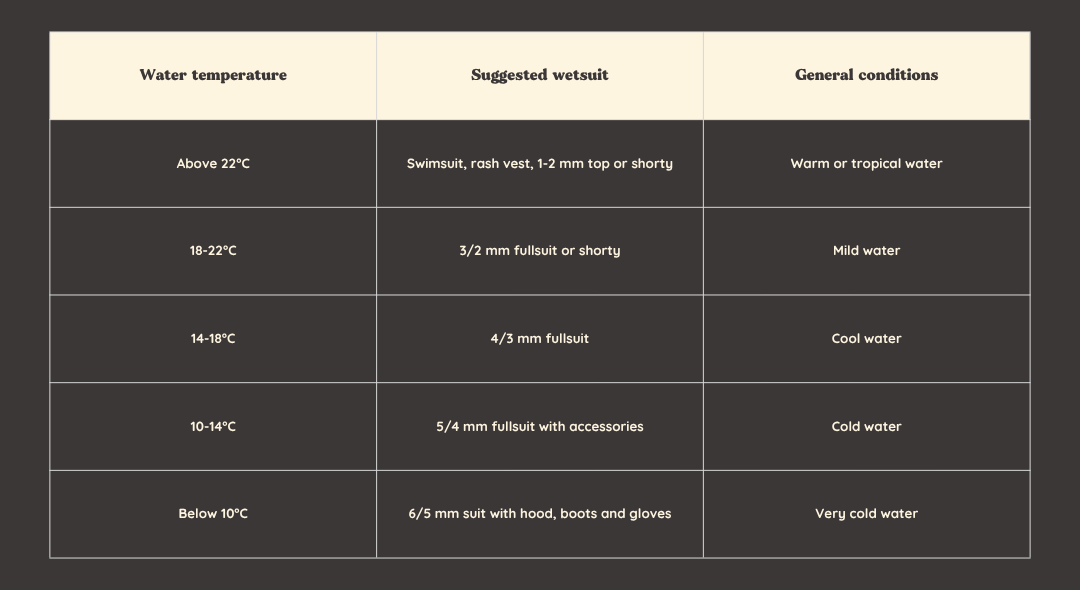
These temperature ranges are merely general recommendations for choosing the right wetsuit thickness.
Your personal tolerance for cold, the wind, the length of your surf session, the time you spend sitting on your board, and the quality of the wetsuit all influence which thickness will feel comfortable for you.
If you tend to get cold easily, a slightly thicker wetsuit might be the better choice. Another surfer, however, might feel perfectly comfortable in a thinner suit under the same conditions.
Is a thicker wetsuit always better?
No. While thicker neoprene keeps you warmer, it often offers slightly less freedom of movement.
A very thick wetsuit can make paddling more strenuous, especially if it doesn't fit perfectly. At the same time, a wetsuit that is too warm can become uncomfortable during an active surf session.
The goal is not to buy the thickest wetsuit available. Instead, choose the thinnest wetsuit that keeps you comfortably warm in the conditions at your surf spot.
Still confused by all the numbers?
Check out our Instagram video with Jesule, surf instructor at Villa Andalucia. He explains what the different wetsuit thicknesses mean and helps you find the right neoprene thickness for your surf sessions.
Watch Jesule's wetsuit guide on Instagram now
Fullsuit or shorty: Which wetsuit is right for you?
Once you understand the different neoprene thicknesses, the next question arises: How much of your body should your wetsuit cover?
The two types that surf beginners encounter most often are fullsuits and shorties.
1. What is a fullsuit?
A fullsuit is a long wetsuit that completely covers your torso, arms, and legs.
It offers more warmth and protection than a shorty, making it a particularly versatile choice for moderate and cooler conditions.
A fullsuit also provides better protection against:
- Sun exposure
- Wind and wind chill
- Skin irritation from the surfboard
- minor scratches and abrasions
- cold water on your arms and legs
For many beginner surfers in Europe a 3/2 or 4/3 fullsuit is a practical and versatile choice.
2. What is a shorty wetsuit?
A shorty is a wetsuit with short legs and usually short sleeves. However, some models combine long sleeves with short legs.
Shorties are primarily designed for warmer water . They are lightweight, offer plenty of freedom of movement, and are generally easier to put on and take off than a fullsuit.
However, they provide less warmth and offer less protection for your skin against the sun, wind, and chafing from the surfboard.
A shorty can be a great choice for warm summer surf sessions, tropical surf destinations, or shorter surf courses in mild water temperatures.
3. What other types of wetsuits are there?
When looking for your first surfing wetsuit, you may come across a few other variations:
- Wetsuit tops or neoprene jackets: Protect the upper body and are particularly suitable for warm water.
- Long John wetsuits: Long legs but no sleeves – ideal if you want more freedom of movement in the shoulder area.
- Spring suits: Lightweight wetsuits for warm water and transitional conditions.
- Hooded fullsuits: Warm fullsuits with an integrated hood for surfing in cold water.
When buying your first surfing wetsuit you don't need to know every single variation. Start by looking at the water temperature of your surf spot and then decide whether a fullsuit or shorty better suits your conditions.
.png)
How should a surfing wetsuit fit?
The Wetsuit fit is just as important as the right neoprene thickness.
Even a perfectly warm wetsuit won't work properly if it's too loose. Large gaps allow fresh water to constantly flow through the suit. This effect is known as "flushing" . Every time cold water enters, you lose some of the heat your body has built up inside the wetsuit.
Your surf wetsuit should therefore fit like a second skin.
It should fit snugly against your chest, lower back, arms, and legs without restricting your breathing or range of motion.
Also, keep in mind: A wetsuit often feels tighter when dry. Once you are in the water and moving around, the material usually becomes a bit more supple and comfortable.
How do you know if your wetsuit fits correctly?
A well-fitting wetsuit should:
- fit snugly against your lower back
- have as few wrinkles as possible around the stomach and waist
- seal well at the neck, wrists, and ankles
- allow you to easily raise both arms above your head
- allow for squats and a deep surfing stance
- not restrict your normal breathing
- give your shoulders enough freedom of movement for paddling
When trying it on, you should move as if you were already in the water.
Rotate your shoulders, stretch your arms forward, get into your surfing stance, and mimic a few paddling strokes. A changing room isn't the ocean, but these simple movements will quickly tell you if your wetsuit is too tight or restricts your range of motion.
How can you tell if a wetsuit is too big?
Your wetsuit might be too bigif:
- excess material gathers at the lower back
- large folds form under the arms
- there are visible gaps at the neckline
- the wetsuit shifts when you walk or raise your arms
- the knee pads are not positioned correctly
- water can easily flow through the suit
Don't just choose a larger size because it feels more comfortable when trying it on dry. A loose wetsuit might feel nice in the surf shop, but it can quickly lead to you getting cold in the ocean.
How can you tell if a wetsuit is too small?
Your wetsuit might be too smallif:
- you cannot breathe comfortably and normally
- the neck area feels uncomfortably tight or causes pain
- your shoulders feel severely restricted
- you cannot fully raise your arms
- the suit pulls tightly at the knees or in the crotch
- the zipper is very difficult to close
- your hands or feet start to go numb
A wetsuit should fit snugly and close to the bodywithout causing pain or significantly restricting your range of motion.
Chest Zip, Back Zip, or Zip-Free: Which wetsuit closure is the best?
In addition to neoprene thickness and fit, surf wetsuits also differ in their closure systems.
The most common versions include Back Zip, Chest Zip, and Zip-Free. Which system is best for you depends on factors such as your personal preferences, your flexibility, and your surfing experience.
Back-zip wetsuit
With a back-zip wetsuit a long zipper runs along the back.
These wetsuits are generally very easy to put on and take off. The larger opening makes it easier to get into the suit, which is why back-zip wetsuits are very popular with beginner surfers.
One potential drawback: depending on the design, a little more water can seep in around the neck and zipper area.
Chest-zip wetsuit
With a chest-zip wetsuit , there is a smaller entry opening in the upper chest area.
Chest-zip models often provide a very snug fit while offering plenty of freedom of movement in the back and shoulder areas. For these reasons, many experienced surfers choose this closure system.
However, putting them on and taking them off can be a bit more difficult—especially at first.
Zip-free wetsuit
A zip-free wetsuit has no traditional zipper at all. Instead, flexible and elastic openings allow you to get into the wetsuit.
The big advantage is the high level of freedom of movement. However, putting it on and taking it off takes some practice. A zip-free model is therefore not automatically the best choice if you are looking to buy your first surf wetsuit .
As a beginner surfer, you shouldn't focus too much on the closure system. Fit, warmth, and freedom of movement are more important when buying your first wetsuit than whether you choose a chest zip, back zip, or zip-free model.
.png)
Choosing a wetsuit: 5 simple steps to finding the right one
Are you looking to buy your first surfing wetsuitbut aren't sure about the thickness, style, or size? Follow these five simple steps to find a wetsuit that suits your surf spot, the water temperatures, and your personal tolerance for the cold.
Step 1: Check the water temperature
Start by researching the typical water temperature at your surf spot and keep in mind the time of year you plan to surf there.
Don't rely solely on the weather forecast or air temperature when choosing your wetsuit. Even on a sunny, warm day, the ocean can be significantly colder.
Step 2: Choose the right neoprene thickness
Use the water temperature as a starting point to determine the right wetsuit thickness .
Select a neoprene thickness that keeps you reliably warm without restricting your range of motion or making paddling unnecessarily strenuous.
If you are torn between two thicknesses, consider these two factors: How easily do you get cold, and how long do you usually stay in the water?
If you tend to get cold quickly or plan on longer surf sessions, you will often feel more comfortable in a slightly warmer wetsuit.
Step 3: Choose between a fullsuit or a shorty
In colder water, windy conditions, or for longer surf sessions a fullsuit is generally the better choice.
In warm water and for shorter sessions, however, a shorty wetsuit can provide sufficient warmth and protection.
The same applies here: the local conditions and your personal sensitivity to cold are the deciding factors.
Step 4: Trying on the wetsuit correctly
Take enough time when you are trying on a wetsuit.
Make sure that the areas designed for your knees, hips, shoulders, and elbows are positioned correctly. Pull the neoprene up bit by bit instead of trying to pull the entire suit into place from the top.
Once the wetsuit is fully on, test your breathing and range of motion. Raise your arms above your head, move your shoulders as if you were paddling, and get into a typical surfing stance.
The wetsuit should fit snugly like a second skin, but it should not restrict your breathing or your movements.
Step 5: Ask a local surf instructor
When choosing the right wetsuit, local knowledge is particularly valuable.
A local surf instructor knows which neoprene thickness makes sense for the time of year, how the wind affects your surf session, and which equipment is best suited to the local conditions.
At a Surf Spirit Retreat , our surf instructors will help you choose the right surf gear for the local conditions and your personal experience level.
This way, you don't have to worry about which wetsuit is the right one and can focus on what really matters: Learning to surf, making progress, and enjoying your time in the water.
.png)
Common mistakes beginners make when buying a wetsuit
One of the most common mistakes when buying your first wetsuit is choosing one that is too big because it is easier to put on and feels more comfortable when dry.
Other typical mistakes made by beginner surfers include:
- Focusing only on the air temperature instead of the water temperature
- Assuming that a thicker wetsuit is automatically better
- Choosing the size based solely on height
- Ignoring the range of motion in the shoulder area
- Prioritizing design over a good fit
- Wearing cotton clothing under the wetsuit
- Pulling hard on the neoprene with your fingernails when putting it on
When choosing the right wetsuit size, your weight, body shape, torso length, and shoulder width play just as important a role as your height.
Two people with the same height may therefore require different wetsuit sizes.
The same principle applies to the rest of your surfing equipment as a beginnerYour equipment should support your surfing and make your progress easier – not make surfing unnecessarily difficult.
Using the wrong gear is just one of several common beginner mistakes that are easy to avoid.
Before your next surf session, read our guide on the five most common surfing mistakes for beginners and how to avoid them.
How to properly care for your wetsuit: Make your gear last longer
With the right wetsuit care , your wetsuit will stay flexible, comfortable, and functional for longer.
After every surf session, you should:
- Rinse your wetsuit with fresh, cool water.
- Turn the wetsuit inside out.
- Let it dry in a shaded area.
- Avoid direct sunlight.
- Do not use a washing machine or dryer.
- Only store the wetsuit once it is completely dry.
Also, avoid hanging a heavy, wet wetsuit on a thin clothes hanger for long periods. The extra weight can put unnecessary strain on the material in the shoulder area and cause it to lose its shape.
It is better to hang the wetsuit over a bar at waist height or use a wide hanger specifically designed for wetsuits.
Hot water, direct sun, and a hot car can damage the neoprene.
Treat your wetsuit with care – this will keep it flexible for longer and help it last through many surf sessions.
Wetsuit Checklist for Beginners
Before you buy or rent a wetsuit, you should ask yourself the following questions:
- Is the neoprene thickness suitable for the local water temperature?
- Do I need a fullsuit or a shorty?
- Does the wetsuit fit snugly against my lower back?
- Can I breathe normally and comfortably?
- Can I move my shoulders freely?
- Are there any large gaps at the neck, wrists, or ankles?
- Can I perform paddling motions and squats without feeling restricted?
- Have I asked a local surf instructor or surf shop about the local conditions?
The best wetsuit for beginner surfers is not automatically the most expensive or technically advanced one.
The right wetsuit fits your body, the water temperature, and the conditions at your surf spot. At the same time, it offers enough freedom of movement so you can focus on what really matters: catching waves and learning to surf.
Once you have understood the three most important factors – water temperature, neoprene thickness, and fit – choosing between different surf wetsuits becomes much easier.
Frequently asked questions about surf wetsuits
Which wetsuit thickness is best for beginners?
The right wetsuit thickness for beginners depends primarily on the water temperature.
A 3/2 mm wetsuit is often worn in mild water temperatures, while a 4/3 mm wetsuit is better suited for cooler conditions.
Always check the water temperature and seasonal conditions at your surf spot before your session. If you are unsure, it is worth asking a local surf school or instructor.
Should a wetsuit for beginners fit tightly?
Yes. A surf wetsuit should fit snugly and close to the body, without restricting your breathing or the freedom of movement in your shoulders.
Large folds, air pockets, or gaps are usually a sign that the wetsuit is too big. Pain, numbness, or severely restricted movement, on the other hand, suggest that it is too small.
Fullsuit or shorty: which is better for beginners?
A fullsuit is usually more versatile for beginner surfers, as it provides more warmth and protection.
A shorty can be a good choice if you are surfing in warm water or planning shorter surf sessions in the summer.
Ultimately, it is not just your experience level that matters, but above all the water temperature and the conditions at your surf spot.
Do I need to buy a wetsuit for my first surf lesson?
No, not necessarily.
Many surf schools, surf camps, and surf retreats provide the appropriate surf equipment for beginners . Renting or hiring a wetsuit first can actually be a smart move.
This way, you can find out which neoprene thickness, fit, and type of wetsuit feels best for you before you buy your own.