
Why proper preparation is so important
Sri Lanka is a dream destination that attracts more and more travelers for good reason. Whether you're into hiking, surfing, relaxing, or swimming, Sri Lanka has something for everyone. To start your trip stress-free, you should think about a few things early on. Before you get into the actual planning, it's worth considering exactly what time of year you want to visit Sri Lanka. Feel free to check out our latest blog post Best time to visit Sri Lanka: Seasons, climate & insider tips for more! There are also a few important logistical points you should take care of in advance. These include things like your visa, vaccinations, and travel insurance. You should also look into payment methods for your trip, a SIM card or eSIM, and your travel arrangements in good time. As a precaution, you can also inform your bank about your trip to avoid your card being temporarily blocked due to unusual transactions abroad.

Before your trip: What you should sort out in advance
Here are the most important logistical points to address before you depart. Remember to look into these topics early and prepare everything you need.
Visa for Sri Lanka: What you need to know
Before entering Sri Lanka, you should definitely check the current entry requirements. Since May 25, 2026, travelers from 40 different countries—including Germany, Spain, Italy, France, Belgium, Austria, Switzerland, the Netherlands, and the UK—have the option to apply for an Electronic Travel Authorization (ETA) online. This allows for a stay of 30 days. You should apply for your travel authorization before your trip via the official Sri Lanka ETA website. It is also important that your passport is valid for at least six months at the time of entry, has at least two blank pages, and that all the information you provide in your ETA application matches the details in your passport.
Since entry requirements can change from time to time, it is important that you check the current situation carefully before your trip (-> Federal Foreign Office & official Sri Lanka ETA website).
Vaccinations, health, and travel insurance
There are currently no mandatory vaccinations required for entry from Germany. However, the Federal Foreign Office still recommends vaccination against Hepatitis A. Depending on your travel route and personal circumstances, other vaccinations—such as those for Hepatitis B, typhoid, or dengue—may also be worth considering. Be sure to consult a doctor about this and check for the latest information. It is also important to address the question of vaccination protection early on, as some vaccines require multiple doses spaced several months apart. Also, ensure that your routine vaccinations are up to date.
Another important point is mosquito protection. Especially during the day, you should try to protect yourself from mosquito bites using repellent and appropriate clothing to avoid infection with the common dengue fever.
And finally: make sure to arrange travel health insurance with sufficient coverage in good time. The Federal Foreign Office also recommends medical evacuation insurance.

Currency, Money, and Local Payments
The Sri Lankan Rupee (LKR) is the local currency of Sri Lanka. As of September 2026, one euro is equivalent to approximately 382 Sri Lankan Rupees. However, the exchange rate fluctuates constantly, so it is best to check the current rate just before your trip (->Exchange rate). Even though card payments are widely accepted, you should still carry cash with you. You will definitely need cash for paying for tuk-tuk rides, shopping in smaller stores, or when traveling in remote regions.
Flights, Arrival, and Best Time to Book
It is best to start comparing flights and prices early. Doing thorough research is especially worthwhile for popular travel times.
From Europe, there are currently several direct flights operated by SriLankan Airlines, for example from Frankfurt, Paris, or London directly to Colombo. However, which connections are active can vary seasonally. Flights with layovers, often in Doha, Dubai, or Istanbul, are offered by airlines such as Qatar Airways, Emirates, Etihad Airways, or Turkish Airlines. Feel free to check out our highlight Flights on Instagram, where we have summarized all the information about flights for you!
By the way: the assumption that flights are generally cheaper on Tuesdays or Wednesdays is now largely considered a myth. Instead of relying on a specific day of the week, it is worth comparing prices for different travel dates and looking for suitable connections early on. The season also plays a role, of course, as flights tend to be cheaper in the off-season.

The Packing List: Clothing for Sri Lanka
What you should pack depends primarily on the time of year, the region, and your planned activities. We have summarized the most important things for you here
Lightweight clothing for the tropical climate
First of all, the good news: since Sri Lanka is tropically warm all year round, you can pack relatively light. Lightweight, breathable clothing should therefore be high on your packing list. Temperatures on the coast are between 29°C and 31°C year-round, so you can leave your winter jacket at home. If you are traveling in the highlands, however, you should still think about a few warmer items of clothing, as it is often significantly cooler there than on the coast.
Clothing for temple and cultural visits
When visiting temples in particular, you should make sure to dress appropriately. Even if you are dressed for the summer, you should have the option to cover your shoulders and knees. Lightweight trousers or airy skirts, for example, are comfortable choices. A light scarf is also super practical and perfectly sufficient for covering your shoulders.
Rainy season basics, if you are traveling during this season
Due to the two monsoon systems, Sri Lanka's southwest and northeast coasts take turns experiencing the rainy season. Depending on your destination and the timing of your trip, you should be prepared for some summer rain showers. If your trip falls during the rainy season, a light rain jacket or poncho and quick-drying clothing should definitely be on your packing list. Dry bags can also be very practical for protecting important documents from moisture, for example. A waterproof cover for your backpack can also be quite helpful. As a rule, however, it doesn't rain all day during this time, so you should still pack your summer clothes and just be prepared for short showers.
.jpeg)
The packing list: Health, hygiene, and little extras
Insect repellent, sunscreen, and a travel first-aid kit
As mentioned, it is especially important to protect yourself from insect bites in Sri Lanka. Insect repellent and long, thin clothing should definitely be in your suitcase. It is also super important to protect yourself sufficiently from the sun. Even in the off-season, you shouldn't underestimate the power of the sun. So, definitely pack enough sunscreen. Here, too, light scarves or thin, long clothing can help. You should definitely not forget sun protection, especially when surfing and swimming. In addition, a well-equipped travel first-aid kit belongs on your packing list. Besides a sufficient supply of personal medication, it is definitely worth having the essentials like bandages or painkillers with you.
Our tip: High-quality sunscreen in particular can be expensive locally or unavailable in the brands you are used to. So, it's best to bring your favorite sunscreen from home!
Sustainable hygiene products for on the go
Sustainability is a big topic, especially when traveling. When packing, you can avoid unnecessary waste with small decisions. Unfortunately, things like travel-sized soaps and disposable products always create a lot of waste when traveling. You can avoid this by switching to alternatives like solid shampoo. For products where that isn't as easy, reusable containers can be a good alternative. Things like makeup remover wipes or cotton pads can also be easily replaced these days with reusable makeup remover pads and similar alternatives.
Tech, camera, and things you tend to forget
In addition to your smartphone, your packing list could include a power bank, headphones, and charging cables. If you enjoy taking photos with your camera, that should definitely come along, too. Think about things like an extra memory card, a spare battery, and the appropriate charging equipment. Depending on your home country, you should also look into a suitable power adapter. For emergencies, it is worth saving important documents like your passport digitally on your smartphone. Also, consider in advance whether you need a SIM card or eSIM for your smartphone and take care of it before your trip if necessary.
).jpeg)
Activity extras: What you need additionally depending on your travel plans
What is crucial for your packing list is primarily what you want to do during your trip. Here is a brief overview:
For surfing: Equipment and clothing
Of course, you don't necessarily have to bring your own surf equipment. Wetsuits are generally not needed due to the high water temperature, and surfboards can be rented in many places.
If you still want to be as well-prepared as possible for surfing, there are a few things that are particularly worth it: reef booties can protect your feet in rocky or coral-rich areas, a rash guard protects you from the sun and chafing, and a zinc stick is practical for particularly sun-sensitive areas on your face. Surf wax for warm water also belongs on the list if you are bringing your own board. Earplugs can also be useful, especially if you spend a lot of time in the water. And for small reef cuts, a mini bandage kit in your surf luggage can't hurt.
If you are coming to Sri Lanka to surf, you should check out our personal surf guide for the south of Sri Lanka check it out!
For yoga and wellbeing: little helpers
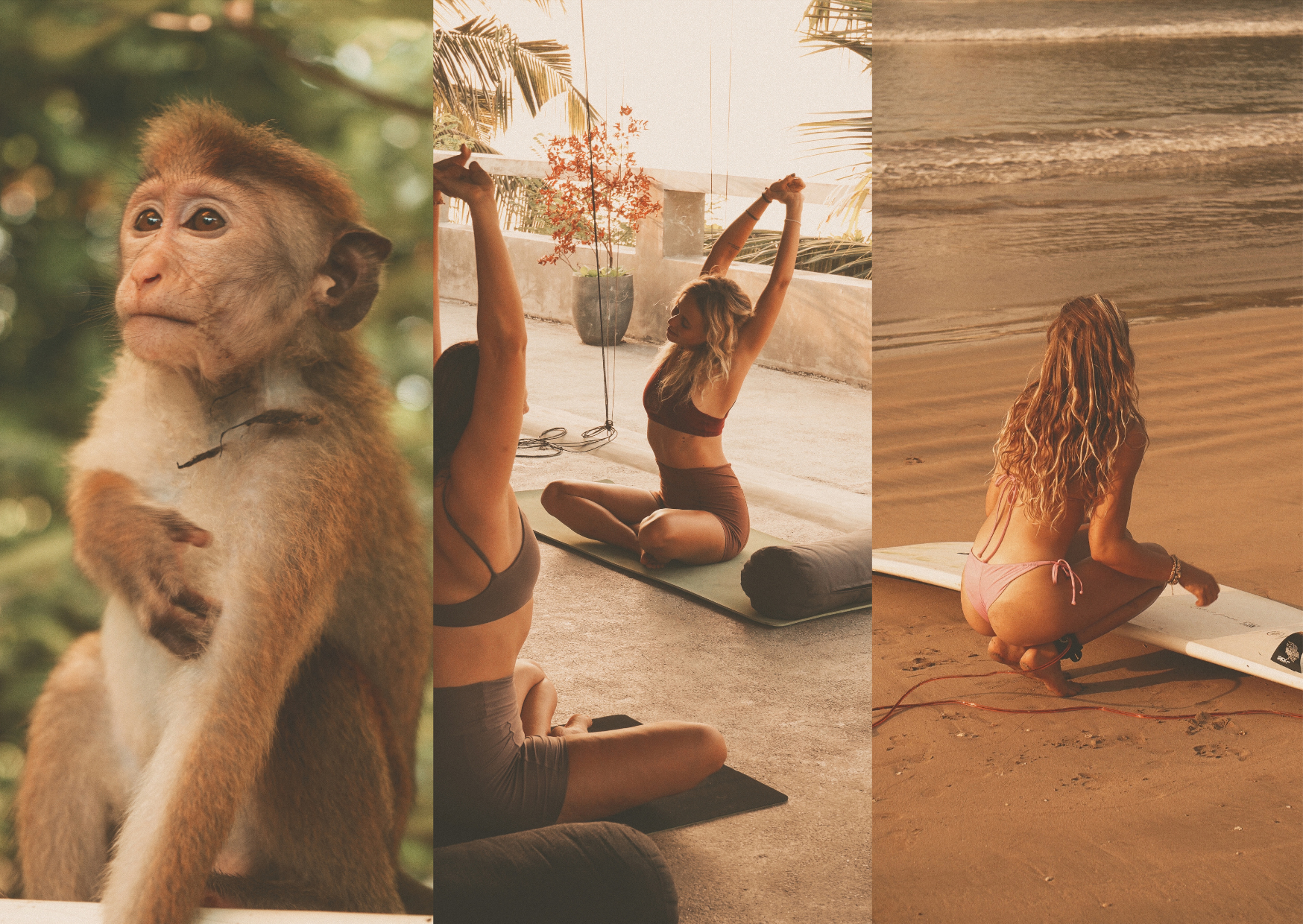
Pack comfortable clothes for yoga that make you feel good. With light leggings, a sports bra, a small water bottle, and perhaps a light sweater to throw on for particularly early yoga sessions, you'll definitely have the basics covered. At retreats like ours in the Jungle Villa and the Beach Lodge yoga mats are generally provided. However, it's best to check in advance just to be sure.
For hiking, safari, and sightseeing
Beyond the coast, Sri Lanka also offers a beautiful highlands region, tea plantations, national parks, and breathtaking wildlife. For these, you should primarily think about good footwear, light breathable clothing, a small backpack with a water bottle, as well as mosquito repellent and sunscreen. Especially in the highlands, it can get significantly cooler than on the coast, so you should also bring some warmer clothing to layer up.
What you're better off leaving at home
As is often the case with travel, less is usually more when it comes to a trip to Sri Lanka. While you should have one or two warmer items of clothing with you, they shouldn't make up the bulk of your luggage. You can also feel free to leave behind overly elaborate outfits, heavy jeans, too many shoes, or huge toiletry bags. Also, keep in mind that there are some wonderful shops in Sri Lanka where you might want to buy a piece of clothing or two. So, plan some space for the return trip, especially if you find it hard to say no when shopping.
What guests most often forget at our retreats
From experience, we can say: it's usually the little things that seem so obvious when packing that you end up forgetting them anyway. Instead of racking your brain over what you need for a trip to Sri Lanka compared to other regions, we recommend that you just think carefully about your everyday essentials.
Practical tips for packing your suitcase for Sri Lanka
We all know the feeling. You might be under time pressure and trying to pack as lightly as possible, but in the end, the suitcase is still too heavy. That's why we've put together these tips to make your packing stress-free so you can focus entirely on the excitement!
Carry-on vs. checked luggage: What goes where
You should pack everything you need during your journey in your carry-on. But items you absolutely cannot do without once you arrive should also be kept in your carry-on, as there can always be issues with checked luggage. It is therefore important to keep essential documents, your medication, your wallet with cash and bank cards, and other important personal items in your carry-on. Additionally, it can be useful to pack a change of clothes in case your checked luggage gets lost or arrives late. Most importantly, however, keep all documents required for your flight and entry—such as your passport, ETA, and flight tickets—with you at all times. Also, pay attention to general baggage rules regarding liquids and other items. For this reason, electronic devices like power banks, laptops, tablets, or cameras should also be kept in your carry-on, while carrying liquids in checked luggage is usually less complicated than in your carry-on. Especially for a long journey, it's worth having a charging cable or a power bank with you.
Your packing checklist
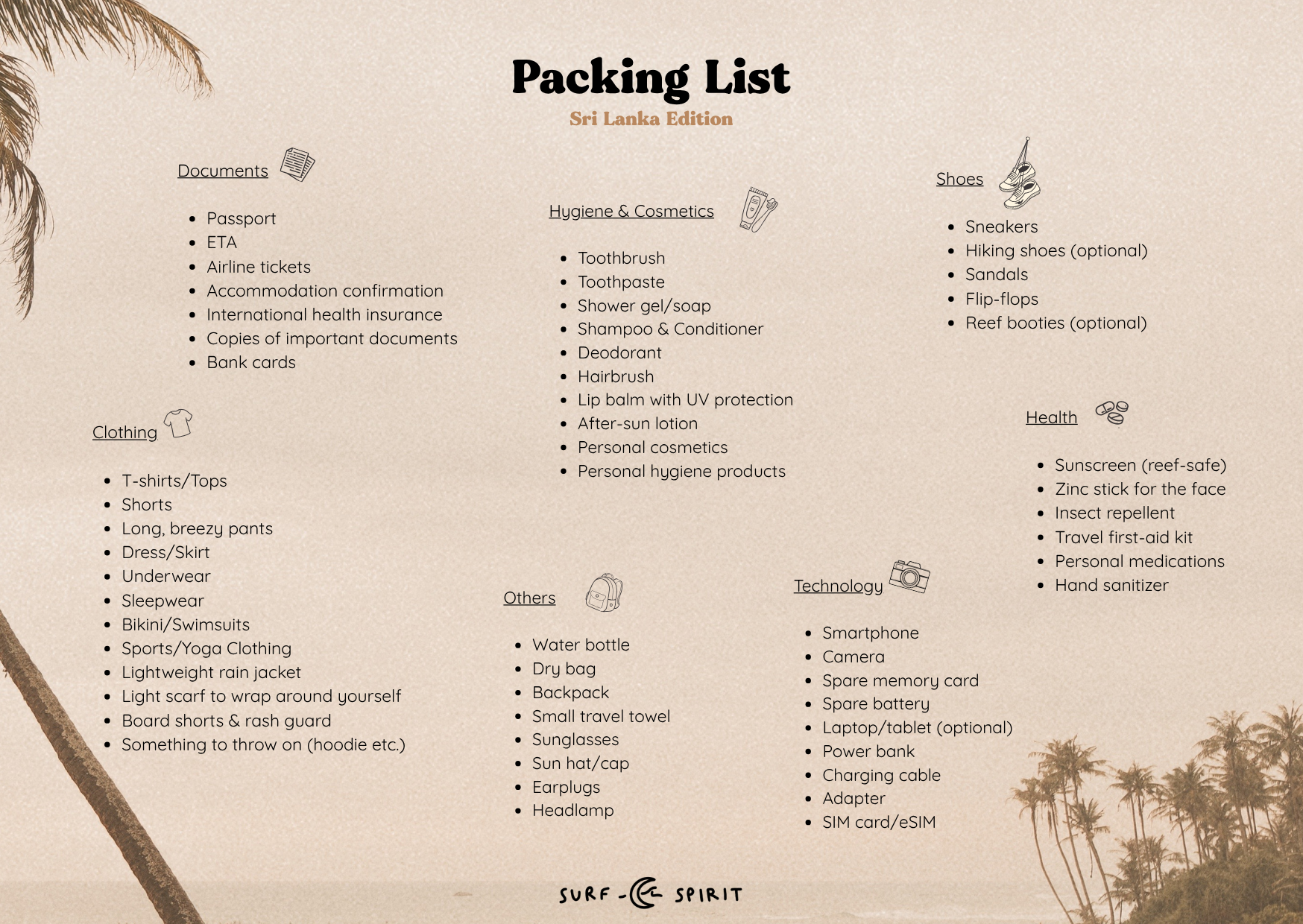
Pro tip: Using packing cubes helps keep your luggage well-organized and can even save you space, as everything is packed away very compactly.
Conclusion: Traveling to Sri Lanka well-prepared
The perfect packing list for your trip doesn't have to be long. In the end, you usually need less than you expect—especially on round trips, it can be a hassle to lug too much around with you. So, think carefully about what you really need and what will just end up sitting unused in your suitcase.
Also, check what amenities your accommodation provides so you don't carry unnecessary weight. And don't worry: you can buy most things on-site if you really need to.
Therefore, priority should be given to important documents and medications. In the weeks before your departure, keep an eye on current information such as entry requirements or flight details.
And most importantly: amidst all the preparations and packing lists, don't forget to get excited about your adventure!
If you want to do more than just travel through Sri Lanka and instead experience it with surfing, yoga, and a community, then definitely check out our website and our retreats at the Beach Lodge and the Jungle Villa !
.jpeg)
.jpeg)